The Critical Link Between Lighting Controls Rebates and DLC Requirements White Paper
This white paper explores the critical link between lighting control rebates and DLC requirements with D4i as a key enabler for plug-and-play integration, power monitoring, diagnostics, and asset data. This paper explores how DLC requirements influence rebate eligibility; why utilities increasingly incentivize lighting controls; the growing role of controllability and interoperability; the evolution from fixture rebates to system-based incentives; and the future relationship among DLC SSL, LUNA, Networked Lighting Controls, and D4i-enabled luminaires.
The Critical Link Between Lighting Controls Rebates and DLC Requirements
With D4i as a Key Enabler for Plug-and-Play Integration, Power Monitoring, Diagnostics, and Asset Data
Executive Summary
Utility rebate programs across North America are rapidly evolving from simple fixture replacement incentives toward comprehensive energy-efficiency strategies centered on intelligent lighting controls. At the center of this transformation is the DesignLights Consortium (DLC) and its Qualified Products Lists (QPLs), which utilities increasingly use to determine eligibility for lighting rebates and advanced controls incentives.
Historically, lighting rebates focused primarily on LED fixture efficacy. However, as LED adoption has matured, utilities are shifting their attention toward maximizing operational energy savings through advanced lighting controls such as occupancy sensing, daylight harvesting, high-end trim, scheduling, adaptive dimming, and networked lighting controls (NLC).
D4i strengthens this transition by giving luminaires a standardized digital foundation for plug-and-play component integration, power and energy monitoring, diagnostics, and asset data. Instead of treating the luminaire as a sealed electrical load, D4i helps turn it into a data-rich node that can support rebate documentation, commissioning, maintenance, and long-term energy verification.
Today, DLC qualification is no longer simply a product-performance benchmark. It has become a foundational requirement for participation in many utility rebate programs and a critical framework for validating controls interoperability, controllability, and measurable energy savings.
This white paper explores:
- How DLC requirements influence rebate eligibility
- Why utilities increasingly incentivize lighting controls
- The growing role of controllability and interoperability
- How D4i enables plug-and-play lighting ecosystems, power monitoring, diagnostics, and asset data
- The evolution from fixture rebates to system-based incentives
- The future relationship between DLC SSL, LUNA, Networked Lighting Controls, and D4i-enabled luminaires
Introduction: Why Lighting Rebates Are Changing
Commercial lighting rebate programs were originally designed to accelerate the transition from legacy lighting technologies, such as fluorescent and HID systems, to LED luminaires. That market transformation has largely succeeded. LED adoption is now widespread across commercial and industrial facilities.
As a result, utilities face a new challenge: achieving additional energy savings beyond baseline LED efficiency improvements. Lighting controls have emerged as the next major opportunity because controls strategies can reduce lighting energy consumption, improve persistence of savings, and provide operational data that supports energy-efficiency program goals.
Controls strategies can reduce lighting energy consumption by:
- Turning lights off when spaces are unoccupied
- Dimming fixtures based on available daylight
- Reducing light levels during low-activity periods
- Enabling scheduling and adaptive operation
- Monitoring and optimizing energy usage in real time
D4i is important in this context because it standardizes how data can be exchanged inside the luminaire between the LED driver, sensors, and controls. This makes it easier to commission luminaires, capture reliable operating data, and support rebate programs that increasingly value measurable performance rather than fixture wattage alone.
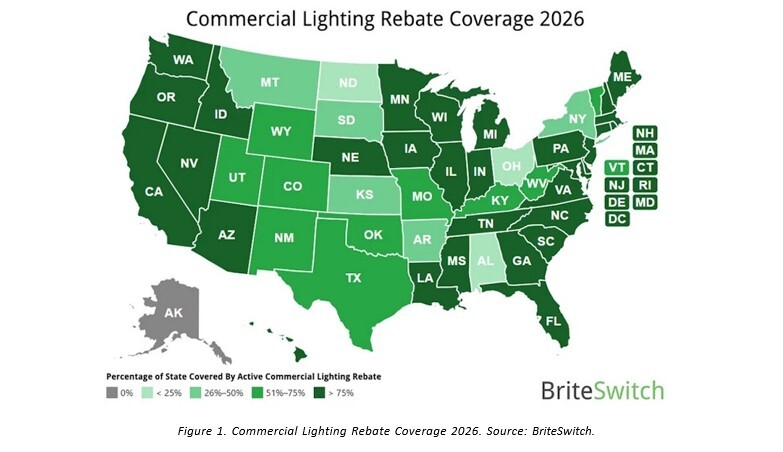
The breadth of rebate coverage reinforces why DLC alignment matters. Where active commercial lighting rebate programs are available, utilities commonly use DLC qualification as a screening tool for eligible products and controls. This makes DLC status a practical go-to-market requirement, not just a technical credential.
What Is the DLC?
The DesignLights Consortium is a nonprofit organization that develops technical requirements and Qualified Products Lists (QPLs) for commercial lighting and lighting controls products.
The DLC serves as an independent performance authority for:
- Commercial LED lighting products
- Networked lighting controls systems
- Outdoor lighting systems
- Advanced controllable luminaires
Utilities throughout North America rely heavily on DLC QPLs to determine rebate eligibility because the listings provide standardized validation of product performance and energy-saving capability. As controls requirements continue to expand, the DLC framework increasingly helps utilities identify products and systems that can support deeper savings through controllability, interoperability, and data-driven operation.
Why Utilities Depend on DLC Requirements
Utilities administer large energy-efficiency incentive programs and need consistent methods to verify that rebate dollars produce reliable savings. DLC requirements provide a common technical foundation for evaluating product performance, controls capability, and system eligibility.
DLC requirements provide:
- Independent performance verification
- Consistent testing methodologies
- Standardized efficacy metrics
- Documented controls capabilities
- Interoperability validation
- Reliable energy-savings assumptions The DLC Qualified Products List simplifies:
- Product selection
- Incentive qualification
- Energy savings calculations
- Controls categorization
- Documentation review
D4i complements this structure because it provides standardized luminaire-level data that can help utilities, contractors, and building owners understand what is installed, how it is operating, and whether the system is performing as expected over time.
The Shift Toward Controls-Based Rebates
Traditional rebate structures rewarded fixture replacement primarily based on wattage reduction. Modern rebate programs increasingly focus on operational energy optimization. This shift is occurring because LED savings alone are no longer enough, utilities need persistent operational savings, grid management is becoming increasingly critical, and controls create measurable long-term savings.
Examples of advanced controls strategies include:
- Occupancy sensing
- Daylight harvesting
- Adaptive dimming
- Scheduling
- High-end trim
- Task tuning
D4i improves the effectiveness of these strategies by making the luminaire more intelligent and easier to integrate. With D4i drivers, controls can access standardized data such as power use, operating status, driver information, and luminaire data, helping bridge the gap between installed equipment and verified performance.
DLC Requirements and Controls Integration
Recent DLC technical requirement updates significantly expand controllability and controls reporting requirements. Controllability, interoperability, and networked lighting controls integration are becoming central to rebate qualification strategies.
The DLC now emphasizes:
- Lighting controllability
- Controls interoperability
- Luminaire-level controls
- Networked Lighting Controls integration
- Advanced dimming capability
- Communication protocols
Under SSL V6.0 and LUNA V2.0, controllability is becoming central to rebate qualification strategies. This makes standardized communication between luminaires, controls, sensors, and software increasingly important.
D4i supports this direction by creating a standardized digital interface inside the luminaire. The result is a more repeatable approach to integrating drivers, sensors, and controllers, which can reduce design-in complexity and help projects qualify for controls-focused rebate pathways.
Networked Lighting Controls (NLC) and Rebate Expansion
Networked Lighting Controls are becoming one of the fastest-growing rebate categories in the commercial lighting industry. NLC systems provide centralized lighting management, scheduling automation, occupancy analytics, adaptive dimming, energy reporting, and demand response capability.
Utilities increasingly offer:
- Standalone controls rebates
- Bonus incentives for controls integration
- Enhanced rebates for luminaire-level controls
- Incentives for advanced control strategies
D4i-enabled luminaires can strengthen NLC value by giving the controls platform access to luminaire-level information that would otherwise be difficult to collect. This includes driver data, power consumption, fault information, and asset attributes that support commissioning, troubleshooting, and long-term operations.
Why D4i Is Key: Plug-and-Play, Power Monitoring, Diagnostics, and Asset Data
D4i, an extension of the DALI-2 control standard, is designed for digital communication inside the luminaire. It helps standardize how LED drivers, sensors, and lighting controllers share information. For rebate programs and DLC-aligned projects, this matters because D4i helps convert a luminaire from a simple controllable load into an intelligent, data-producing system component.
D4i Capability: Why it matters for DLC/Rebate Aligned Projects
- Plug-and-Play Integration: D4i standardizes communication between drivers, sensors, and controllers within the luminaire. This helps reduce custom engineering, lowers integration risk, and supports multi-vendor ecosystems.
- Power and Energy Monitoring: D4i can provide access to operating data such as power consumption, voltage, current, wattage, and energy-related
information. This helps verify savings, identify abnormal performance, and support energy reporting. - Diagnostics and Fault Visibility: D4i enables diagnostic data from drivers and luminaires, including fault flags, counters, and time-based data. This allows controls platforms to detect issues earlier and support predictive maintenance.
- Asset Data: D4i can expose driver and luminaire information such as manufacturer, model number, date code, wattage, and other identifying attributes. This simplifies commissioning, warranty support, maintenance, and rebate documentation.
- Lifecycle Operations: Because D4i data remains useful after installation, it supports ongoing optimization, service planning, and system
verification rather than ending its value at the time of rebate submission.
Interoperability Is Becoming Essential
A major challenge in lighting controls adoption has historically been interoperability between fixtures, sensors, drivers, controllers, and building management systems. DLC requirements increasingly address this issue by encouraging standardized communication methods and documented controls capabilities.
Technologies frequently associated with this transition include:
- DALI-2
- D4i
- Wireless mesh controls
- Luminaire-level lighting controls (LLLC)
- Networked lighting controls
D4i is especially important because it focuses on the data and power relationships inside the luminaire. By standardizing those internal relationships, D4i makes it easier for external networked controls platforms to treat luminaires as intelligent nodes that can be discovered, configured, monitored, and maintained more consistently.
DLC LUNA and the Growing Role of Outdoor Controls
The DLC LUNA program demonstrates how controls are now intertwined with environmental and sustainability objectives. LUNA-qualified products must support advanced dimming capability and controllability requirements intended to reduce sky glow, minimize light trespass, lower nighttime energy consumption, and support adaptive outdoor lighting.
D4i can strengthen outdoor lighting strategies by supporting dimming, monitoring, and asset visibility at the luminaire level. In outdoor and roadway applications, this data can help operators identify failed or underperforming drivers, confirm expected power draw, and manage large distributed lighting inventories more efficiently.
Lighting controls are no longer viewed solely as energy-saving tools. They are becoming environmental compliance tools as well.
Financial Impact of Controls-Based Rebates
Controls integration can dramatically improve project economics. Modern rebate programs increasingly provide per-fixture controls incentives, sensor rebates, networked controls rebates, bonus incentives for advanced controls, and energy-savings-based custom incentives.
The rebate trend data below shows that many LED luminaire categories continue to receive meaningful incentives. As product rebates remain available, adding controls and D4i-enabled data can help projects qualify for stronger incentive packages and improve the financial justification for advanced lighting systems.
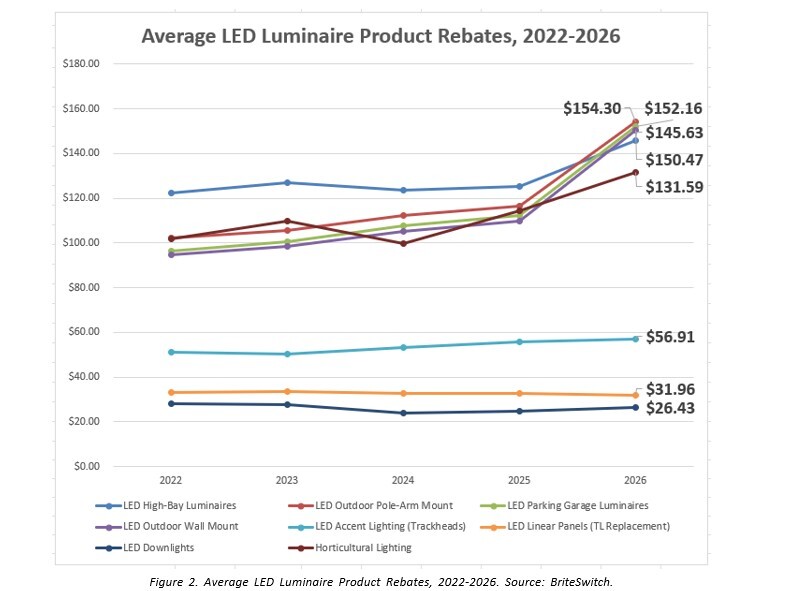
For D4i-enabled luminaires, the rebate story becomes stronger because the control system can do more than dim lights. It can support plug-and-play installation, provide power monitoring, report diagnostics, and capture asset data that helps document what was installed and how it performs over time.
Benefits for building owners include:
- Reduced project payback periods
- Lower operational costs
- Improved energy reporting
- Enhanced occupant comfort
- Better compliance with energy codes
- Improved sustainability metrics
D4i can make the financial case stronger by adding operational visibility. Power monitoring can confirm whether expected energy savings are being realized. Diagnostics can reduce maintenance costs by identifying issues before they become widespread failures. Asset data can reduce labor during commissioning, audits, and warranty work. Together, these capabilities help move the rebate conversation from first-cost reduction to lifecycle value.
Future Outlook
The relationship between DLC requirements and rebate eligibility will continue to strengthen. Several industry trends are accelerating this transition, including increasing energy code requirements, electrification pressures on the grid, demand-response initiatives, smart building adoption, sustainability mandates, dark-sky regulations, and data-driven facility management.
Future rebate programs will likely place even greater emphasis on:
- Connected lighting systems
- Interoperability
- Real-time monitoring
- Adaptive lighting
- Data reporting
- Integrated building systems
- HVAC integration to take advantage of Lighting Presence Sensors
D4i is well aligned with this future because it helps make luminaires data-rich, interoperable, and easier to manage over time. As rebate programs evolve, technologies that provide verified equipment data, power data, diagnostics, and commissioning support will become increasingly valuable.
Conclusion
The commercial lighting industry is undergoing a fundamental transition from fixture-based efficiency toward intelligent, connected lighting ecosystems. At the center of this transformation is the growing link between utility rebates and DLC technical requirements.
Utilities increasingly rely on DLC qualification to validate product performance, controls capability, interoperability, energy savings potential, and advanced lighting strategies.
D4i adds an important technical layer to this transition. It supports plug-and-play integration between drivers, sensors, and controllers; provides access to power and energy data; enables diagnostics and fault visibility; and exposes asset data that can simplify commissioning and maintenance.
The future of lighting rebates is no longer just about efficient luminaires. It is about intelligent, controllable, interoperable, and data-rich lighting systems that can prove their value over the full life of the installation.
Chart source note: Rebate coverage and average luminaire rebate trend charts included in this paper are sourced from BriteSwitch.